
The stock of commercial vehicle (CV) company Ashok Leyland is up 46 per cent in the past three months, gaining despite worries about a slowdown in sales volume. Brokerages have a mixed view on the country's second-largest medium and heavy commercial vehicle manufacturer. The company reported steady March quarter results and its valuation, focus on growth and medium-term prospects are positive, but some brokerages are cautious, given near-term demand concerns and the risk of competition increasing in the industry.

Reliance holds 67.03% of Jio Platforms Limited and the public listing would provide an exit to many investors.

Pradip Shah, managing director, IndOcean, feels that although gold has done reasonably well, it doesn't really create too much value in the long run.

With the earnings season drawing to a close, stock markets will take cues from global trends and foreign investors' trading activity this week, analysts said. The US FOMC (Federal Open Market Committee) minutes will be the major highlight this week, experts said. "This week, there are fewer cues on the macro and micro fronts, as the Q1 earnings season has concluded.

Trading activity of foreign investors and global trends will be the major driving factors for the equity markets in a holiday-shortened week ahead, according to analysts. Leading stock exchanges BSE and NSE have declared a trading holiday on November 20 for assembly elections in Maharashtra. Elections to the 288-member state legislative assembly will be held on November 20, and votes will be counted on November 23.

In an eventful week ahead, stock markets may face volatile trends before the RBI's interest rate decision and the US inflation data announcements, as investors continue to assess the broader implications of US tariffs on global economy and inflation, analysts said. Investors fear that a full-blown trade war will impact global trade and economic growth, according to market experts.

Stocks of Indian steel companies are reeling from pricing pressure that is partly blamed on cheap imports. The stocks have declined up to 9 per cent on the NSE in one month, likely allowing investors an opportunity to use the correction to enter the pack as pricing pressure eases. "In steel or any other commodity, if prices or spreads are nearing their bottom, it can be an opportune time to invest in those stocks. In India, domestic fundamentals such as steel consumption remain robust, hence one can take fresh positions in these counters," said Amit Dixit, an analyst at ICICI Securities.

With the absence of any major immediate domestic trigger in sight, investors would focus on global trends and trading activity of foreign investors for further cues in a holiday-shortened week ahead, analysts said. Movement of global oil benchmark Brent crude and rupee-dollar trend would also guide the market. "This week is a truncated one with no major triggers expected. However, we anticipate sector-specific movements amid budget-related buzz.

Benefiting from higher credit off-take and loan repricing, listed commercial banks are expected to post 43.9 per cent year-on-year (YoY) growth in their net profit in the quarter ended June 30 (Q1FY24), analysts have said. Controlled credit costs due to a healthy asset quality profile and a steady treasury book will also support a strong bottom line for the lenders in the first quarter. However, net profit may shrink sequentially, according to analysts' estimates for 13 banks sourced from Bloomberg data.
Pharmaceutical major Matrix Laboratories has emerged as the fastest wealth creator while state-owned Oil and Natural Gas Corporation
Motilal Oswal Financial Services has posted a net profit of Rs 20.4 crore, a sharp drop of 62 per cent compared to the corresponding period of the previous year. The fall is attributed to the tough market conditions. Kochi-based Geojit Financial Services has posted profit after tax of Rs 38.63 crore after the company received Rs 40 crore as compensation from BNP Paribas for discontinuing the commodity business.

A host of macroeconomic data announcements, the last batch of September quarter earnings, global trends, and trading activity of foreign investors will be the major driving factors for the equity market this week, according to analysts. Equity markets would remain closed on Friday for Guru Nanak Jayanti. "India is set to release CPI and IIP data on November 12, with WPI data expected on November 14.
Reliance Money has emerged as the top brokerage house in terms of online security and cost effectiveness, while Motilal Oswal leads as the most research driven stock trading platform, a survey says.

Fast-moving consumer goods (FMCG) companies are expected to witness pressure on volumes in the October-December quarter. However, price hikes will help push up revenues, said brokerages.For India's largest engineering firm, Larsen and Toubro (L&T), the analysts expect a 20 per cent growth in consolidated revenue, and an 8.1 per cent core business Ebitda margin, up 40 bps from a year ago.

The top 20 fund houses held 6.8 per cent of their portfolios in cash as of May 31, down from a record high of 7.2 per cent in April 2025.

Equity markets will take cues from the US tariff related developments, global trends and trading activity of foreign investors this week, analysts said.
The turbulence witnessed by the stock market this year has adversely affected brokers but Motilal Oswal, Chairman and Managing Director, Motilal Oswal Financial Services says he is unruffled. "Revenues have been hit if you compare them on a quarterly basis. The earnings were exceptionally high during the last two quarters of 2007, as the benchmark indices rose more than 30 per cent during the period. Given the swift rise in share prices, this slowdown was expected."

'Those satisfied with returns and not expecting further rally could be booking profits and also stopping SIPs.'
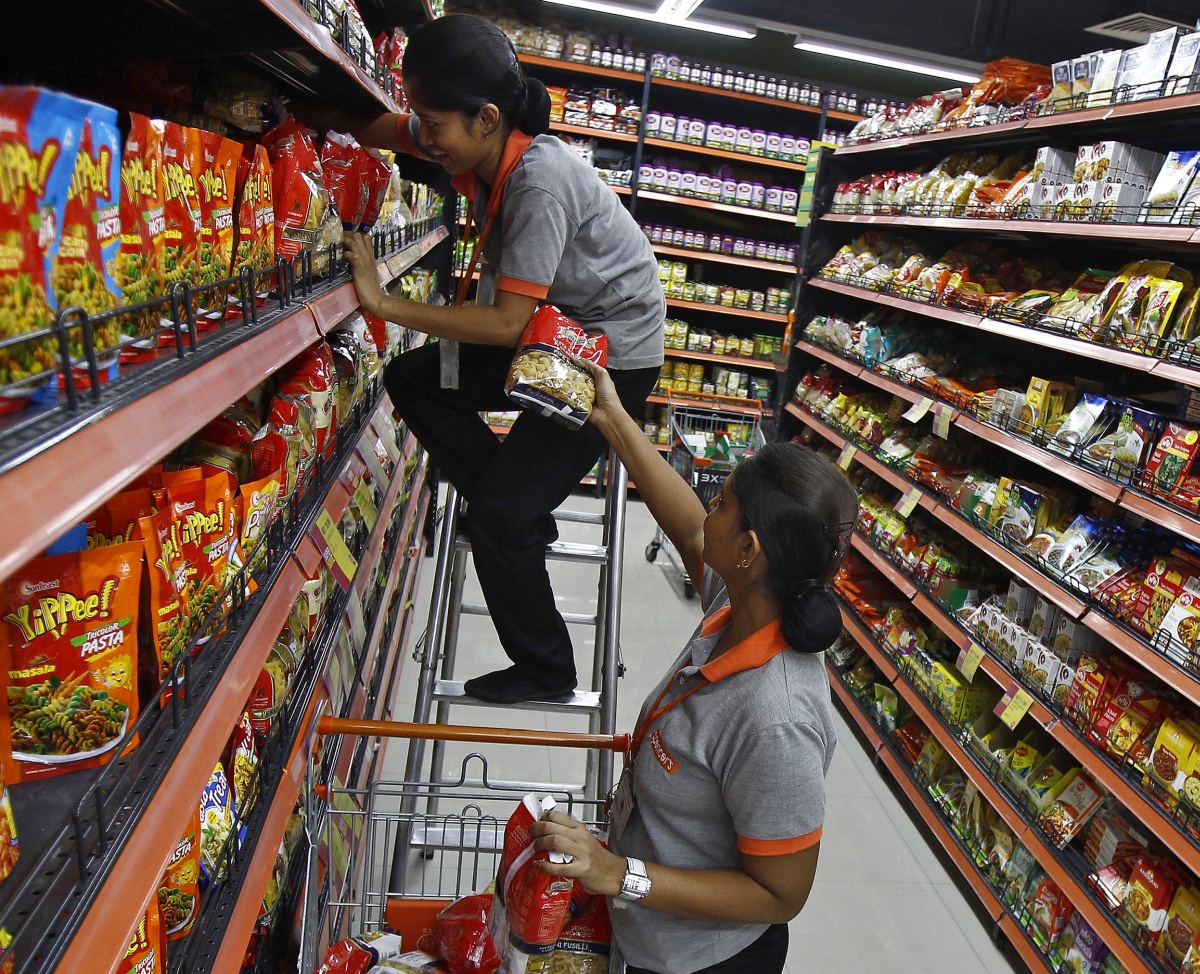
However, rural demand continued to remain a concern for FMCG companies during the quarter.

Tata Motors reported a consolidated net profit of Rs 17,483 crore (adjusted for exceptional gains and losses) for Q4FY24, surpassing TCS' consolidated net earnings of Rs 12,434 crore. For the automotive major, this marked a 213.7 per cent year-on-year increase in the bottom line, from Rs 5,573.8 crore a year ago. In contrast, India's biggest IT firm saw a more modest Y-o-Y growth of 9.1 per cent in net profit, from Rs 11,392 crore.

Investors' wealth plummeted by Rs 5.49 lakh crore on Friday as markets faced a massive correction tracking a weak trend in global peers and fresh foreign fund outflows. Falling for the third day running, the 30-share BSE Sensex tumbled 1,017.23 points or 1.24 per cent to settle at 81,183.93. During the day, it plunged 1,219.23 points or 1.48 per cent to 80,981.93.

Macroeconomic data announcements, trading activity of foreign investors and global trends will guide equity market movement this week, which would also mark the beginning of the new calendar year and month, analysts said.

Life Insurance Corporation of India (LIC) has made the most of the stock market boom by reducing stakes in all its top conglomerates during the financial year 2023-2024 (FY24). However, even after reducing exposure, the value of its remaining stake has gone up substantially across all groups, according to data collated from stock exchange filings.

Analysts expect Nifty to rise up by to 6 per cent in six months, with intermittent corrections likely due to global factors.

Global fund managers witnessed one of their largest-ever declines in assets under custody (AUC) during the ongoing correction in the Indian markets, as stocks came under pressure from foreign outflows and the weakening rupee.

Better than expected performance in June quarter of the 2023-24 financial year (Q1FY24) and a robust outlook led to 1.2 per cent gain in Titan Company stock on Friday (July 7). The firm reported 20 per cent growth in revenues, aided by double-digit rise in its major consumer segments. Jewellery, its largest segment, accounting for about 90 per cent of its sales, stood out with a growth of 21 per cent over the year ago quarter.

India Inc's profit share in the country's GDP at 15-year low in 2018. Since 2013, net profit for top 500 companies has remained in the range between Rs 4 trillion and Rs 4.8 trillion despite steady growth in nominal GDP.

Quarterly earnings from corporates, the US Fed interest rate decision and other global trends will be the major driving factors for determining movement in the domestic equity market in a holiday-shortened week ahead, analysts said. Besides, factors like trading activity of foreign investors, global oil benchmark Brent crude and rupee-dollar trend would also influence trading.

Strong margins in the jewellery segment in Q4FY25, steady growth guidance for FY26 and expectations of outperformance in the organised jewellery sector boosted sentiment for the largest listed jewellery maker by market capitalisation, Titan Company. The stock was the highest gainer on the benchmark indices (Sensex as well as Nifty), rising 4.1-4.5 per cent at close on Friday, taking the total gains over the past month to about 12 per cent.

India's most valued company, Reliance Industries Ltd (RIL), reported a robust performance in the third quarter of the current financial year (Q3FY25), surpassing analyst expectations. This coupled with positive commentary by brokerages led to the stock of the oil-to-telecom conglomerate surging as much as 4.44 per cent to hit an intraday high of Rs 1,325.1. It settled at Rs 1,301.3 apiece, up 2.57 per cent.

Shares of Tata Consultancy Services (TCS) declined after the information technology (IT) major reported a 1.3 per cent sequential drop in net profit for the March quarter, prompting several brokerages to cut their target prices. The TCS stock fell as much as 1.26 per cent during the day to Rs 3,205 per share.

Bajaj Auto - the country's most valuable two-wheeler (2W) company by market capitalisation - met Street expectations in the January-March quarter (Q4) of 2024-25 (FY25) but still ended Friday as the worst performer on the Nifty 50, slipping 3.1 per cent.

Global trends, trading activity of foreign investors and domestic macroeconomic data announcements would dictate terms in the equity market in a holiday-shortened week ahead, analysts said. Equity markets would remain closed on Wednesday for Gandhi Jayanti. "Looking ahead, it will be interesting to monitor Foreign Institutional Investors (FIIs) and their flow into India.

Corporate India's net profit as a percentage of gross domestic product (GDP) dipped in the 2022-23 financial year (FY23) -- after rebounding sharply in FY22 -- amid a decline in global commodity prices. Top 500 companies' combined net profit stood at 4.1 per cent of the GDP for FY23, down from 4.3 per cent in the previous financial year when it had gone up from just 3.5 per cent in FY21. "The year-on-year (YoY) decline was led by global commodities, which contributed adversely to the ratio, while the financial sector contributed positively.
Fall in crude prices has eased interest rate worries and that expectation of good Q2 is already factored in the prices.

Mutual funds' largecap investment universe is expected to see seven changes in the upcoming stock reclassification exercise by the Association of Mutual Funds in India (Amfi). According to a report by IIFL Securities, Hero MotoCorp, Zydus Lifesciences, JSW Energy, NHPC, Bharat Heavy Electricals, Bosch and Samvardhana Motherson are expected to earn upgrades in the revised list of largecap, midcap and smallcap stocks set to be released in the first week of July. Amfi revises the list at the start of January and July every year based on the previous six-month performance of the stock.

The Securities and Exchange Board of India (Sebi) on Thursday debarred Ketan Parekh, the stock market operator involved in the stock market scam of 2000, Singapore-based trader Rohit Salgaocar, and one other individual from the securities market for alleged front-running of trades of a United States (US)-based foreign portfolio investor (FPI). The FPI manages around $2.5 trillion worth of funds globally.
Gold price declined Rs 305 to Rs 56,035 per 10 grams in the national capital on Thursday amid a fall in rates of precious metal in the overseas markets, according to HDFC Securities. The yellow metal had settled at Rs 56,340 per 10 grams in the previous trade. Silver also plummeted Rs 805 to Rs 65,095 per kg.
